

The African diaspora is vast and complex, touching nearly every pocket of the world. However, we share a commonality beyond a rainbow of skin tones. It’s in how we feel, relate to each other, and how the world sees us. We can be African American, Caribbean, Latinx, or even simpler, Black.
Black American millennials grew up exposed to Pan-Africanism, a call to action for the young and old to learn and embrace their African roots. We wore Kente cloth and leather African medallions around our necks. For those truly down for the cause, we beckoned the words of Marcus Garvey and Malcolm X to reject American patriotism in exchange for pride in our history and our people. I’ve always been fascinated by and curious about what Blackness is outside of America.

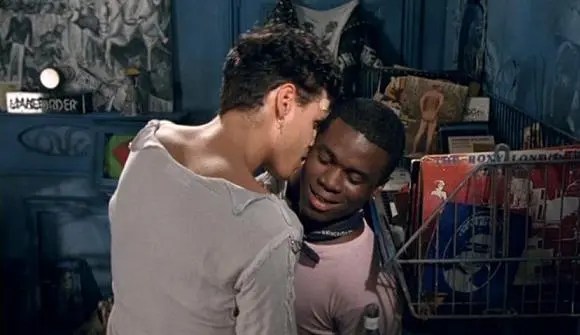
Young Soul Rebels, a 1991 coming-of-age drama, follows the lives of Black UK disc jockeys Chris and Caz as they navigate a tremulous 1977 summer. Co-written and directed by Isaac Julien, we experience how our protagonist navigates racism, class politics, and queer sexuality. The film starts with the murder of TJ, a gay Black man, at the hands of a white man who was cruising him only moments before. Caz, who is gay also, is left stunned after the murder, as he was cruising the same park the same night of TJ’s slaying. Meanwhile, Chris tries desperately for corporate UK radio to hire the DJ duo. The problem? UK radio plays little funk and soul and even less room for Black DJs who want to challenge the establishment.
Without getting too much into spoiler territory (though how bad can you spoil a thirty-year-old film?), it is interesting to experience the mirror of Black UK life and their Black American counterparts. We both fought to infiltrate white corporate structures, both have murky and nasty external and internal racial politics and conflicts, and both have to navigate classism. What makes Young Soul Rebels an extraordinary watch is the exposure of how static the tension was between Black soul boys, white punks, and racist skinheads. In America, we were (and, frankly, are) truly segregated — mostly, Black spaces stayed with us, and white spaces stayed with them. In Young Soul Rebels, punks party in the same clubs as the soul boys, where DJs can pivot from playing the Sex Pistols to Roy Ayers at a moment’s notice. Skinheads proudly hang out in the open spaces during the day and antagonize Blacks and/or folks. Julien built credible tension, and the proximity of these opposing bodies is shocking to experience.


Courtesy of BFI
When the film ended, my thoughts drifted to 1995’s La Haine. On the surface, both films are starkly different (narratively, they are almost 20 years apart and set in different countries). Still, they both explore racial conflicts (this time, between white, Black, and Muslim Parisians) soundtracked by Black music. Time did not ease any tension, as La Haine ratchets up the violence and erases any possibility for compromise. With Young Soul Rebels, we are at least hopeful for the future, while La Haine points a revolver at its head and isn’t afraid to pull the trigger again, and again, and again. In a way, this is how racial tensions of the ‘90s felt in America as well — many remained hopeful for better days while others maintained a defensive skepticism.
Young Rebel Souls is vibrant in color, music, and attitude. The recent 4K restoration pops and funk score from Parliament, The Blackbyrds, and X-Ray Spex are a treat to revisit all these decades later. Chris and Caz reach a crossroads moment in their relationship as DJ partners and friends they may never recover from. Even if the film leaves some questions unanswered (Why was Caz attracted to Billibud?, Do Chris and Caz eventually fallout?, Was the murderer that difficult to spot?), this is a treasure worth discovering.
Rating: 4 out of 5 stars

Other Articles

‘Priscilla’ Is a Beautiful Yet Empty Dream
‘The Exorcist: Believer’ Fails to Possess Its Original Spirit


No Comment! Be the first one.